How to practice speaking a language with ChatGPT voice mode
· Ben Ward
A question we get more and more: why use a speaking app at all, when ChatGPT has a voice mode?
It's a fair question, and the honest answer starts with this: voice mode is real speaking practice. You say something out loud, something answers, and you have to answer back. That loop is the thing most learners never get enough of. If you have ChatGPT on your phone, you can start practicing tonight.
Most people try it once, have a slightly aimless chat, and never open it again. The problem is the blank conversation. Nobody knows what to say into it. So here is how to set it up properly, and then what it leaves to you.
Five prompts that make it work
Type the setup before you switch to voice, or say it at the start. Swap in your own language and situation.
1. Give it a scene and a role. "Chatting" is too vague. A situation tells you what to say.
You are a waiter at a small café in Madrid. I am a customer. Speak only Spanish. Use short, simple sentences for a beginner. Do not switch to English unless I say "pause".
2. Control the length. Left alone, it answers in paragraphs, and you end up listening instead of talking.
Keep every reply to one or two short sentences, then wait for me.
3. Give yourself a goal. A goal is what turns a chat into practice, because you know what you have to say and when you've done it.
My goals: order two drinks, ask if there is anything without milk, and pay by card. Tell me when I have done all three.
4. Save corrections for the end. Being corrected after every sentence kills the conversation. Not being corrected at all teaches you nothing.
Don't correct me while we talk. When I say "finished", list my three most important mistakes, with the correct version of each.
5. Run it again tomorrow. The second time through the same scene is where it gets easier, and easier is the point. Change one detail: the café is out of what you ordered, or you have to split the bill.
That's a genuinely useful setup. For open-ended conversation about anything you like, a film you just watched or an argument you want to practice having, nothing else comes close.
What it leaves to you
None of this is a knock on ChatGPT. It is a general assistant, and these are the parts a general assistant leaves to you.
You have to be the teacher. Every session starts with you writing the scene, picking the level and deciding the goals. On a tired evening, that blank prompt is exactly the thing that stops you starting.
It drifts. Long conversations wander. Replies get longer, the level creeps up, and it can slide back into English when you hesitate. You can steer it back, but steering is attention you are not spending on speaking.
Getting unstuck means leaving the language. When you can't find a word, the natural move is to ask in your own language, and now the two of you are talking about the language rather than in it. There is no hint that gets you just the next few words, and no word on the screen you can tap to check what it meant.
There is no path. Tomorrow you start from nothing again. Nobody has decided which situation should come next, or noticed that you're ready for something harder.
What a speaking app adds
ConvoLive is that setup with the work already done. Each conversation is a real situation with a character, a setting and goals that tick off as you say them. When you get stuck you can ask for a hint, or ask how to say something, and then say it yourself. You can tap any word to see what it means. The characters stay in the language you are learning however long you take, and the course runs from beginner to advanced across 200 scenarios, so tomorrow's conversation is already waiting.
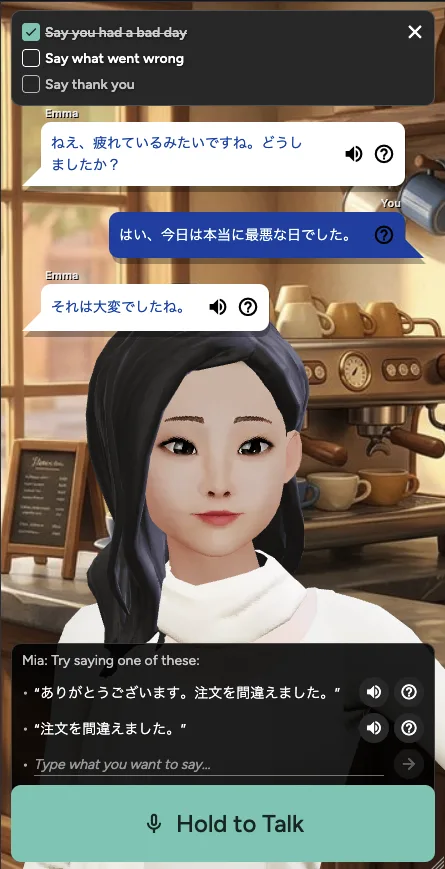
You can practise for free every day, so you don't have to choose. Use ChatGPT's voice mode when you want to talk about anything at all. Use a structured scenario when you want to get better at the conversations you'll actually have, at a café or on your first day at work.
Either way, the rule is the same: say it out loud, every day. The method matters less than the reps.